
Beyond Land Acquisition: Turning Tamanga’s Land Victory into a Viable Housing Community
When community groups set out to tackle poor housing, securing land is rightly celebrated as a major milestone. However, what happens after the title deeds are signed? For the families from Chinsapo, Mtandire, Area 49, and Area 36 in Lilongwe, acquiring land was only the beginning of a complex journey. Bridging the gap between holding raw land and laying the first brick requires immense organizational grit, productive site management, financial discipline, and technical preparation.
Between 2023 and 2024, community members formed a savings group supported by the Centre for Community Organization and Development (CCODE). By February 20, 2025, they formally registered as the Tamanga Housing Cooperative. Mobilizing monthly contributions, Tamanga achieved its first major triumph: acquiring two large sites Ndege (135 plots) and Kudoko in Area 25 (40 plots). Yet holding 175 plots brought a crucial question to the forefront: How does a low-income community transform raw acres into a fully serviced, financially sustainable housing project?
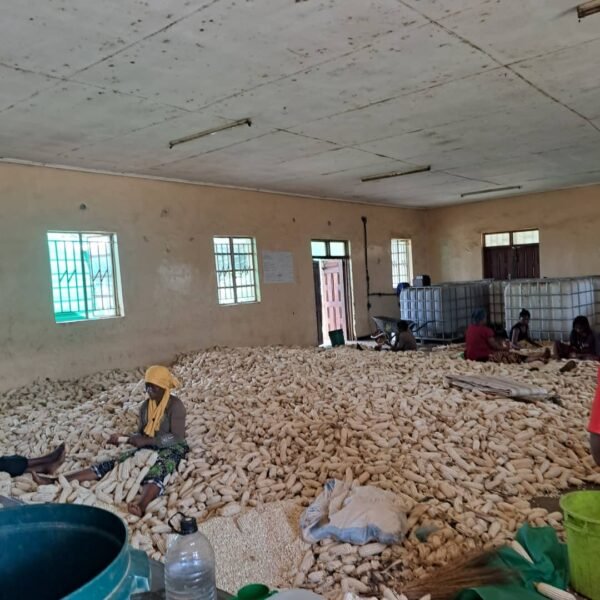
cooperative members shelling maize.
1. Making Idle Land Productive: The Maize Harvest
To address this challenge, Tamanga first tackled one of the greatest risks following land acquisition: allowing site holding costs to drain cooperative momentum while awaiting major construction funds. Mindful of the upcoming agricultural season, members creatively turned their vacant housing sites into productive farmland.
Through collective sweat and farming labor, members cultivated maize on the unbuilt plots, yielding a bumper harvest. Selling the crop generated immediate returns, with every kwacha reinvested directly into the housing fund. By using raw land productively, the cooperative offset holding expenses and built-up capital for initial civil works.
2. Sweat Equity and Site Preparation
Alongside generating early capital through agriculture, transforming open land into site-ready residential plots demanded intensive clearing, grading, and beacon installation. In 2026, Tamanga formed the specialized Plot Allocation and Land Development Committee to oversee pre-construction operations, manage equipment procurement, and allocate plots to members completing their land loan repayments.
To minimize development overheads, members contributed direct sweat equity during site clearing and beaconing. Rather than hiring external crews, members turned up in force to carry water from the nearby river for concrete boundary markers and assist in clearing lines. This hands-on mobilization significantly cut professional contractor costs while fostering shared ownership over the layout of their future community.
3. Financial Rigor and Accountability Systems
[Cooperative members working on their maize harvest]
While physical site preparation progressed, the cooperative recognized that physical development cannot succeed without transparent financial tracking. Managing land loan repayments and monthly share collections required moving away from informal notebook entries toward rigorous accounting tools.
With CCODE’s technical support, cooperative treasurers were trained on standardized registers and distinct receipt systems for shares and loans. As treasurer Florence Nkhoma noted, recording complete member data alongside issuing formal receipts replaced financial ambiguity with trust, providing the exact auditing integrity needed to reassure members and prospective partners before undertaking major building contracts.
4. Building Trust: Receipts, Registers, and Dignity
Establishing these formal accounting mechanisms laid the foundation for deep organizational trust. Previously, payments were recorded informally without receipts or structured registers, creating accounting challenges and understandable anxiety among members.
Recognizing this, CCODE stepped in with essential training on new record-keeping systems. Treasurers were equipped with official registers and distinct receipt books for loans and shares. As Florence Nkhoma, one of the cooperative treasurers, shared emotionally: “Previously, we recorded demographic data in a notebook… Now we keep accurate data safely, recording membership IDs, age, national ID numbers, and family size. The introduction of receipts has built trust and transparency among members since we no longer pay without proof.”
[Plot allocation and land development committee training]
Entering the Construction Phase: Architectural Co-Design
With land cleared, boundaries beaconed, and financial trust firmly established, Tamanga successfully closed the gap between land ownership and actual housing development. On October 5, 2026, CCODE facilitated a landmark co-design session connecting Tamanga leaders with technical experts from Architects Without Borders. This collaboration marks the transition into architectural design and structural engineering, turning a hard-won tract of land into resilient, dignified homes designed specifically around the community’s needs and financial capabilities.

