
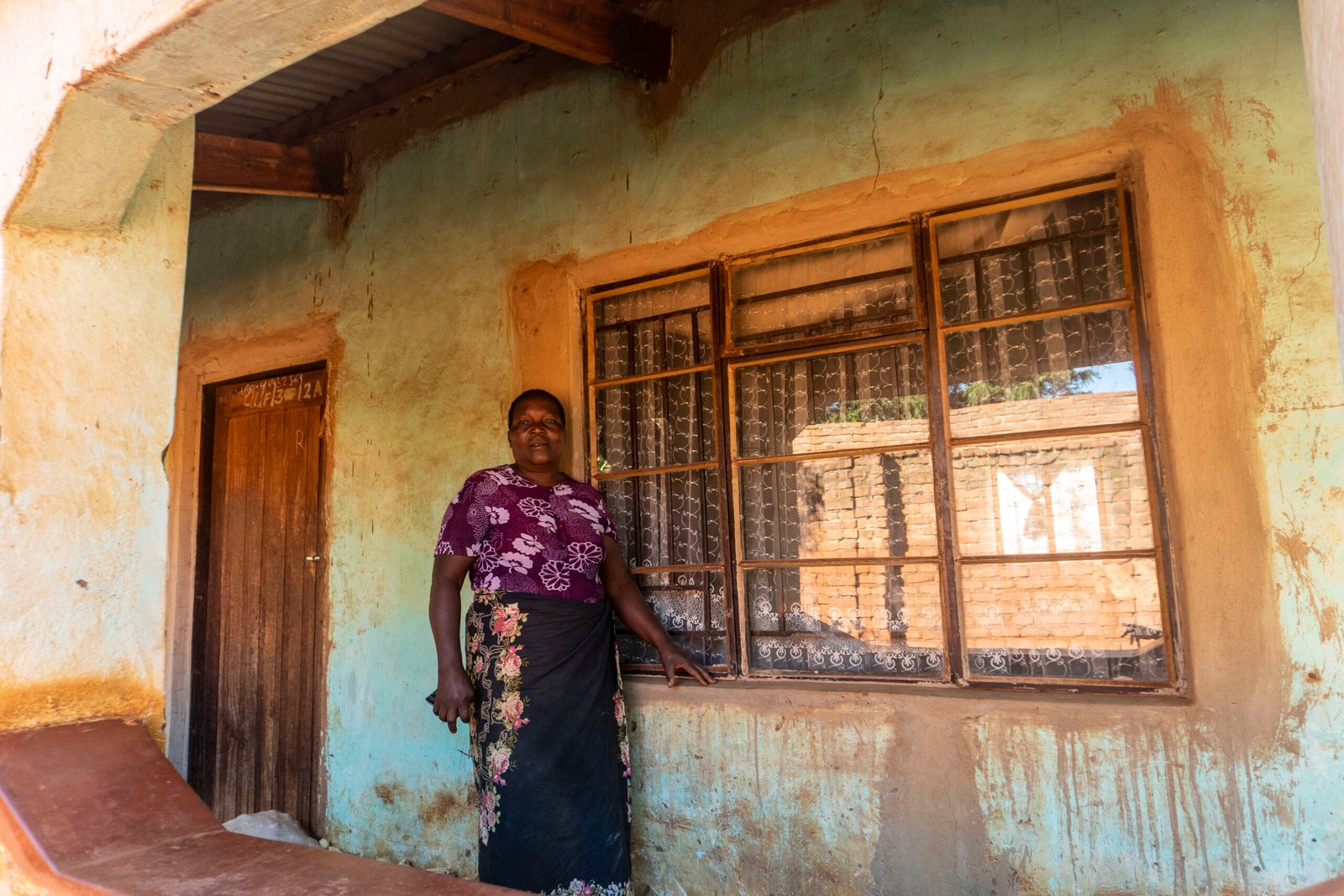
From Shattered Glass to Stronger Walls: Elizabeth’s Journey to a Safer Home
On a windy Sunday afternoon in 2023, just after church, Elizabeth January welcomed a visitor into her home. As a devoted Presbyterian, Sundays are sacred, reserved for worship, rest, and connection with loved ones. That day was no different. Seated in her modest living room alongside her husband and guest, laughter flowed easily, stories overlapping in warmth and familiarity.
Then, without warning, the moment fractured.
A loud crash echoed through the house.
“It was embarrassing,” Elizabeth recalls quietly. “I picked up the broken glass in shame.”
The source of the noise was all too familiar: one of the old wooden window frames had finally given in to the wind. The structure, already weakened by years of exposure, could no longer hold. Though sudden, the incident was not entirely unexpected. It was the physical manifestation of a problem Elizabeth had lived with for years: fragile infrastructure, slowly deteriorating, and increasingly unsafe.
But this time, something shifted.
When the visitor left and the house fell silent again, Elizabeth turned to her husband with a resolve she had not expressed before.
“Enough is enough,” she said.
There was just one problem: they did not know what to do next.
At 52 years old, Elizabeth January carries many roles. A mother of four, a grandmother of three, a waste entrepreneur, and a landlady to cricket infrastructures as a source of income. Her husband is a driver. Together, they have built a life rooted in resilience, navigating the daily realities of urban living with limited but carefully managed resources.
Elizabeth joined the federation in 2011. Over more than a decade, she became known as a disciplined saver and a reliable borrower. Her financial journey within the federation was steady but cautious.
“I used to take small loans of K15,000, then later K35,000,” she explains. “Even that would pinch into my small business.”
These loans supported her livelihood but were never intended for something as significant as home improvement. For years, the idea of taking a larger loan felt too risky, too uncertain, in an already fragile economic environment.
Yet her consistency built something important: credibility.
Within the federation system, Elizabeth had developed a strong credit history. She was trusted. She was eligible. She was, in every sense, capable of accessing bigger opportunities but like many others, she needed a reason to take that step.
The breaking window became that reason.
By 2025, Elizabeth made a decision she had postponed for years.
“I finally gained the courage,” she says.
That year, she accessed a home improvement loan under a housing initiative supported by DESWOS and implemented by the Centre for Community Organisation and Development (CCODE) in partnership with the federation. She received MWK 400,000, a significant amount, yet still modest in the face of rising construction costs.
With careful planning, she prioritized the most urgent repairs.
The weak wooden window frames were replaced with strong, durable metal frames. Proper glass was installed, restoring both function and dignity to the home. For the first time in years, the windows could withstand the wind.
She also purchased cement and a bag of lime, beginning the process of repairing and repainting the interior walls, which had started to crumble over time.
“I wanted to fix everything,” she admits. “But the money was not enough because prices of materials have gone up.”
Her words reflect a broader reality. Across Malawi, the cost of construction materials has risen sharply, making both new housing and home improvements increasingly unaffordable for low- and middle-income households. What MWK 400,000 could achieve a few years ago is no longer the same today.
Still, the impact of the loan was undeniable.
Elizabeth’s house, built in 2009, has four bedrooms and is currently home to four people. Before the improvements, it struggled against the elements. During the cold and windy seasons, air would pass freely through gaps in the damaged window frames, making the house uncomfortable and, at times, unbearable.
The home was not just physically vulnerable it affected the family’s sense of security and well-being.
Today, that has changed.
“The loan was a breakthrough for us,” Elizabeth says with conviction.
The new window frames have transformed the living environment. The house is warmer, safer, and more stable. What was once a source of embarrassment is now a point of pride.
Elizabeth’s story is not just about a broken window. It is about the power of incremental change and the systems that make it possible.
The home improvement loans are designed with a clear understanding of reality: for many urban families, building a new house from the ground up is simply out of reach. The cost of land, building materials, and labour continues to rise, placing formal housing beyond the reach of ordinary citizens.
Instead, these loans offer an alternative supporting families to improve, upgrade, and maintain the homes they already have.
This approach recognizes that dignity does not only come from new structures, but from safe, functional, and well-maintained living spaces.
At the centre of this model is a strong partnership.
The initiative is implemented through collaboration between the federation, CCODE, and DESWOS. Federation members contribute regular savings, which are pooled into a collective fund known as the Mchenga Fund. This fund acts as a safety net, protecting both borrowers and the system in cases where loan repayment becomes difficult.
At the same time, the federation plays a critical role in assessing member eligibility. Through peer accountability and established financial records, members like Elizabeth are evaluated based on their saving discipline and repayment history.
This ensures that loans are not only accessible, but also sustainable.
CCODE, as the implementing partner, provides technical guidance and oversight, supporting communities through the loan process and ensuring that interventions are effective and aligned with local needs.
Together, this ecosystem creates more than just access to finance; it builds trust, responsibility, and long-term resilience.
For Elizabeth, the impact goes beyond physical improvements.
Her home is now a safer space for her children and grandchildren. The fear that once accompanied every strong wind has been replaced with confidence. The embarrassment of that Sunday afternoon has given way to a renewed sense of control over her living conditions.
And perhaps most importantly, her story carries a message for others in similar situations.

