
The strait of Filth
Life, neglect, and survival along a forgotten passage in Mzuzu
Mzuzu, a city of approximately 280,000 people in northern Malawi, is among the fastest-growing urban centers in the country, with an annual growth rate of about 4.27 percent. While this rapid expansion reflects its rising economic importance and its role as a regional hub, growth at this pace is not without consequence. It is evident that the expansion has outpaced infrastructure and public service delivery.
The result is a mounting urban crisis in Mzuzu. Solid waste management has become one of the most visible challenges. With limited collection capacity and weak enforcement, garbage is increasingly dumped in open spaces, drainage channels, and along footpaths. Over time, these sites evolve into informal and illegal dumping grounds, posing serious environmental and public health risks.
In Mzuzu one such a place stands out
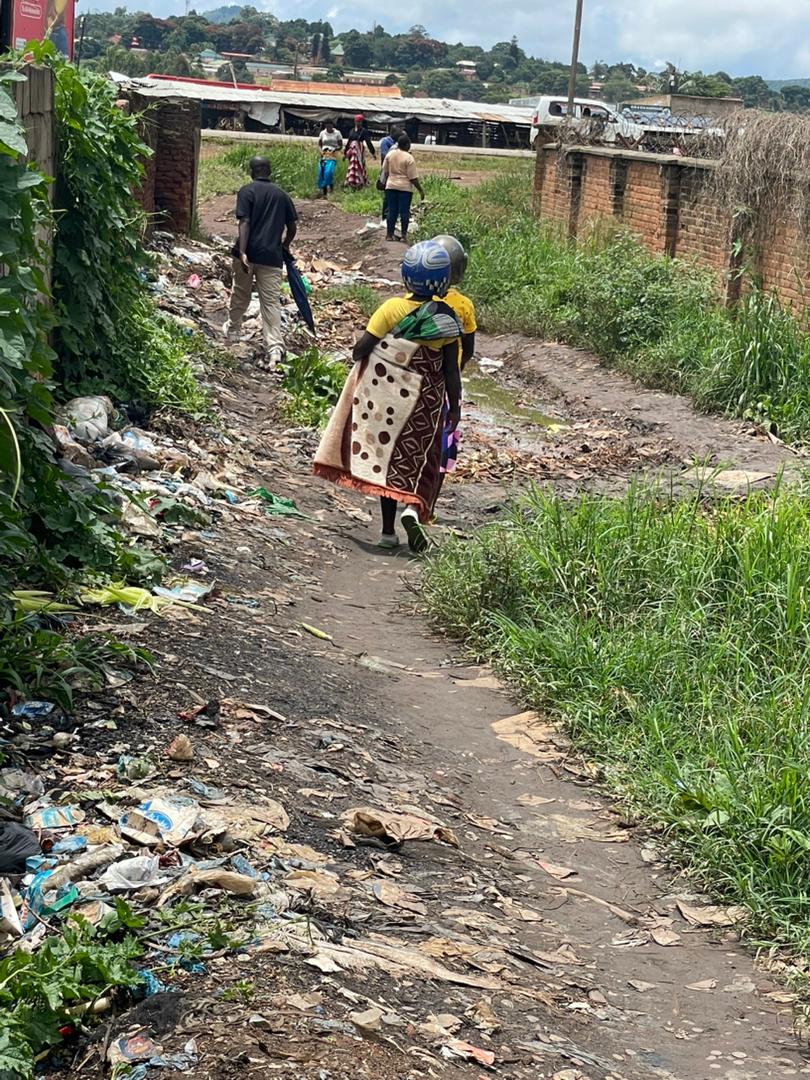
There is a narrow strip of land between St. John of God and the busy M1 Road. It is not marked on maps. It is not planned, maybe it is in city councils records, serviced, or protected. Yet every day, it is used.
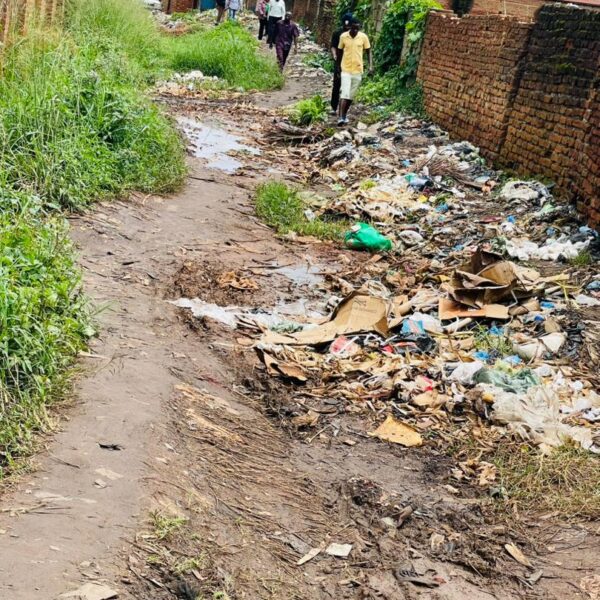
Residents pass through it as a shortcut- an artery of convenience in a busy city environment. But what should be a simple footpath connecting Chibavi, Salisburylines and lower Katoto to Zigwagwa market and up Chiputula and Mzilawayingwe has become something else entirely: a corridor of waste, a slow emergency, a clear indictment of urban neglect.
The ground is layered with discarded life-used diapers, plastic waste, broken glass, strands of hair, and even used condoms. The smell hangs thick in the air. Flies find their paradise. Passers by criss-cross each other, others looking bothered, others not. Just minding their business.
But not everyone passes through this narrow stretch the same way. Children come here too. Not to play, they hustle. Strictly playing out the script of ghetto playbook.
They move carefully among the waste, collecting plastic bottles. And touching everything, almost. These bottles are not trash to them-bottles are currency. Sold to local women who brew thobwa, they become part of an informal economy that survives on what the city throws away. It is a cycle that speaks as much about resilience as it does about desperation.
But responsibility here is not simple.
When I visited the site with the block leader Mr Robbins Mwakibinga, we met the manager of a nearby Chibanja Resthouse. Her frustration was palpable. The growing mound of waste is no longer just an eyesore-it is a security threat. Thieves, she explained, now use the heap as a launching point to jump over the brick fence and access the property. Guests are no longer just inconvenienced; they are at risk.
There is also fear that the pressure from accumulated waste could collapse the wall.
We might have to close off both sides,” she said.
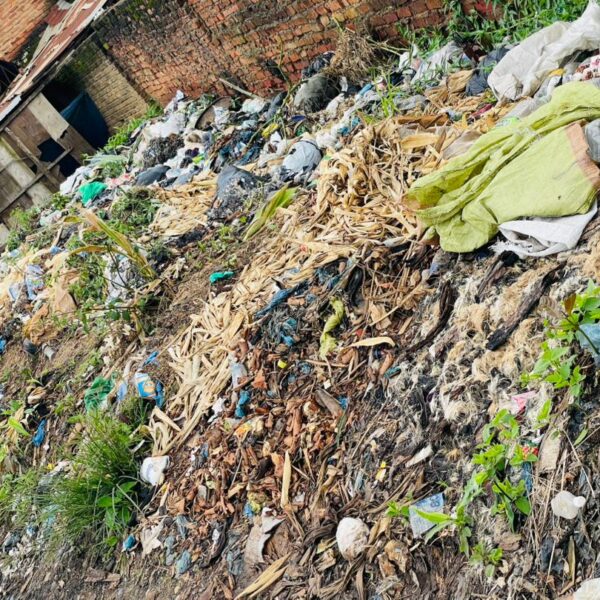
But that is not all that worries community leaders and residents. The growing mound of waste has become a serious public health hazard. During the rains, the accumulated garbage is washed through narrow drainage channels and carried deep into surrounding neighbourhoods, particularly Salisburylines and Chibavi where foodstuffs vendors and children roam freely . What begins as a localized dumping problem quickly spreads, contaminating entire communities.
The consequences are severe and recurring. Outbreaks of cholera have become almost perennial, while diarrhoeal diseases and other sanitation-related illnesses are widespread, particularly among children. The mixture of decomposing waste, stagnant water, and human exposure creates ideal conditions for the multiplication and spread of diseases. For many residents, this is not an occasional crisis but a lived reality- one where poor waste management translates directly into compromised health, strained households, and a constant risk to life.
While the others just want a full enclosure, not everyone sees a dead end. The local ward councillor, Mr. Gabitto Mwaungulu, proposes a different path-literally. He suggests leasing the strip to individuals who can develop small shops. Activity, he argues, will replace neglect. Presence will deter dumping. Commerce will restore order.
It is compelling. Where there is life, there is accountability. Where there is ownership, there is care. But it also raises questions. Who gets access? Who benefits? And what happens to those-like the children collecting plastics-whose survival is tied to the current state of things? In the end benefits and harm must outweigh each other. The one that weighs heavy wins and carries the day.
While Ward Councillor Mwaungulu proposes leasing the strip for small businesses to discourage dumping. It is a compelling idea-but raises questions about inclusion and impact on vulnerable groups.
The strip between St. John of God and the M1 Road is more than a dumping site. It is a mirror. It reflects the tensions of a rapidly urbanizing Malawi, between formal systems and informal realities, between governance and survival, between neglect and ingenuity. It speaks the language of neglect, irresponsibility, unaccountability and blame game.
Calling it The Strait of Filth captures the anger, the rawness, the truth of what it has become. But perhaps it is also something else: It is a test to the city Council, a test to the residents and community leadership. What is seen here raises serious thought provoking questions. Can places of neglect as this be turned into a place of dignity? Can responsibility be shared instead of being shifted?
Light at the End of the Tunnel
There is, however, a glimmer of hope. Under the REDAA project’s Locally-Managed Finance for Urban Ecosystem Restoration: Catalyzing Community-Led Action by Slum Dwellers in Southern Africa, the site has been identified as a priority area for intervention through the Urban Ecosteward Grant Facility. Through this initiative, micro-grants will be provided to support the design and implementation of a more permanent, sustainable solution to the waste crisis.
What sets this approach apart is its emphasis on community stewardship. The grants will be managed directly by the community, empowering residents to take the lead in restoring and maintaining their environment. By placing resources and decision-making power in the hands of those most affected, the initiative offers not just a technical fix, but a pathway toward accountability, resilience, and long-term change.
Author


Bernard Kondowe is a Learning, Compliance and Quality Assurance Officer for CCODE, where he also serves in a Learning, Monitoring and Evaluation (LME) role. He contributes to organizational learning, ensures compliance with standards, and supports quality assurance across programs. In addition, he plays a key role as a communication and digital strategist, managing CCODE’s website and all social media platforms, where he authors and co-authors news articles, blogs, and posts that communicate the organisation’s initiatives, impact, and community development efforts to a wider audience.